
How to Get & Safely Use Narcan in Tampa, FL

What Is Narcan (Naloxone) and How Does It Work?
Naloxone is a life-saving medication that can reverse the effects of an opioid overdose in minutes. If someone you love uses opioids, whether by prescription or otherwise, understanding naloxone could mean the difference between life and death.
When a person takes an opioid like fentanyl, heroin, or a prescription painkiller, the drug binds to opioid receptors in the brain. At safe doses, this produces pain relief. At higher doses, opioids can slow breathing to dangerously low levels or stop it entirely. This is an overdose, and without intervention, it can be fatal within minutes.
Naloxone works by displacing opioids from those receptors. It binds more strongly than the opioid itself, which reverses the overdose and restores normal breathing. Naloxone is classified as an opioid antagonist. It has no potential for misuse, is not addictive, and will not cause harm if given to someone who is not experiencing an opioid overdose.
The U.S. Food and Drug Administration (FDA) approved Narcan (4 mg naloxone nasal spray) for over-the-counter use in March 2023, making it the first naloxone product available without a prescription. A second OTC product, RiVive (3 mg naloxone nasal spray), was approved in July 2023. These approvals opened the door for naloxone to be sold at drug stores, grocery stores, convenience stores, gas stations, and online.
Where to Get Narcan in Florida
Narcan and other naloxone nasal sprays are available throughout Florida without a prescription. Here are the most accessible options for getting naloxone in the Tampa Bay area and across the state:
Pharmacy Purchase (No Prescription Required)
- CVS Pharmacy. Naloxone nasal spray is available at the pharmacy counter. Ask a team member for assistance. Cost typically starts around $45.
- Walgreens. Available at the pharmacy counter without a prescription. Walgreens provides a guide on what to expect when purchasing naloxone.
- Walmart Pharmacy. Narcan is available over the counter at Walmart locations across Florida.
- Publix Pharmacy. Narcan nasal spray is available without a prescription at Publix locations statewide.
Free Naloxone Programs in Florida
- Florida Department of Children and Families Overdose Prevention Program. Since 2016, this state program has distributed free naloxone through a network of more than 600 enrolled community distributors. Visit myflfamilies.com/services/samh/opp to learn more.
- I Save Florida (isavefl.com). A state-run program that provides free naloxone kits and training on how to use them. The website includes an online finder to locate free kits near you.
- Florida Harm Reduction Collective (flhrc.org). In partnership with NEXT Distro, this organization offers free naloxone by mail in Florida. They also provide overdose prevention education and community-based services.
- IDEA Exchange. Based in Miami, this harm reduction organization provides free naloxone, HIV and hepatitis C testing, safe injection kits, wound care, and referrals to addiction treatment. They operate a fixed site and a mobile unit.
How to Use Narcan: Step-by-Step Overdose Response
If you see someone who may be experiencing an opioid overdose, follow these steps. Knowing what to do ahead of time can save a life.
Signs of an Opioid Overdose
- Extreme sleepiness or complete unresponsiveness
- Tiny, pinpoint pupils
- Slow, shallow, or stopped breathing
- Choking or gurgling sounds
- Limp body
- Bluish, cold, or pale skin, especially around lips and fingertips
- Very slow or absent heartbeat
Step-by-Step Overdose Response
- Step 1: Try to get a response. Shout the person’s name. Rub your knuckles firmly on their breastbone (sternum rub). If there is no response, assume an overdose.
- Step 2: Call 911 immediately. Tell the dispatcher your location and say you believe someone has overdosed on opioids. Do not skip this step. Even after naloxone, the person needs emergency medical care.
- Step 3: Administer Narcan. Lay the person on their back. Tilt their head back slightly. Insert the nasal spray nozzle into one nostril and press the plunger firmly. One spray delivers the full dose.
- Step 4: Perform rescue breathing or CPR if trained. If the person is not breathing, give rescue breaths (tilt head back, lift chin, pinch nose, give one breath every five seconds). If you are trained in CPR, begin chest compressions.
- Step 5: Wait and monitor. Naloxone takes two to three minutes to take effect. If the person does not respond after two to three minutes, administer a second dose of Narcan in the other nostril.
- Step 6: Place in the recovery position. Once the person begins breathing on their own, turn them on their side with their top knee bent forward. This keeps the airway open and prevents choking if they vomit.
- Step 7: Stay with the person. Remain until emergency responders arrive. Naloxone wears off in 30 to 90 minutes. If the opioid is still in the body, overdose symptoms can return. The person needs hospital care.
What NOT to Do During an Overdose
- Do not put the person in a cold bath or shower.
- Do not slap, punch, or try to physically shock them awake.
- Do not give them other drugs, stimulants, or fluids by mouth.
- Do not try to make them vomit.
- Do not leave them alone.
Who Should Carry Naloxone?
Opioid overdoses can happen to anyone who uses opioids, including people who take prescribed pain medications exactly as directed. The following groups should strongly consider keeping naloxone on hand:
- Anyone who takes prescription opioids for chronic pain, post-surgical pain, or injury recovery.
- People who use illicit opioids such as heroin or street fentanyl.
- Family members and loved ones of anyone who uses opioids.
- People in recovery from opioid addiction, especially in the first year after treatment. Tolerance drops quickly during abstinence, making relapse-related overdose more dangerous.
- Adults over the age of 65, who face higher overdose risk.
- People who mix opioids with alcohol, benzodiazepines, or other sedating substances.
- First responders, teachers, coaches, and anyone in a position to encounter an overdose.
Florida law now mandates the co-prescribing of naloxone to patients with severe traumatic injuries who receive a Schedule II opioid prescription (such as oxycodone, hydrocodone, or codeine). This reflects the medical community’s recognition that overdose risk exists even among patients who take medications as directed.
Florida’s 911 Good Samaritan Act
Fear of legal consequences can stop people from calling 911 during an overdose. Florida’s 911 Good Samaritan Act (State Statute 893.21) was designed to remove that barrier and encourage people to seek help.
Under this law, a person who acts in good faith to help someone who is overdosing (including themselves) may not be charged, prosecuted, or penalized for possession of a controlled substance if the substance was discovered as a result of seeking emergency assistance.
This protection extends to violations of pretrial release conditions, probation, or parole if the evidence was discovered because of the request for medical help.
The message is clear: calling for help during an overdose is protected. A life is always more important than the fear of consequences.
Naloxone Training and Harm Reduction Resources in Florida
Pre-dosed nasal sprays like Narcan are designed to be simple enough for anyone to use, but training can build confidence and help you act quickly in a stressful moment. The following resources are available in the Tampa Bay area and across Florida:
- Florida Alcohol and Drug Abuse Association (FADAA). Offers free online Narcan and overdose response training.
- American Red Cross. Provides classes in opioid overdose response and Narcan administration, as well as CPR and first aid training across Florida.
- I Save Florida (isavefl.com). Offers training alongside free naloxone kits. The training covers how to recognize an overdose, administer naloxone, and provide basic life support while waiting for EMS.
- River Oaks Treatment Center. Has provided community training on Narcan administration. Check the River Oaks events calendar for upcoming sessions.
- Hillsborough County needle disposal sites. Safe disposal locations for syringes and sharps are available through the Florida Department of Health in Hillsborough County.
- University of South Florida/Tampa General Hospital. Launched one of Florida’s first needle exchange programs in Hillsborough County, offering harm reduction services including naloxone distribution.
Narcan Is Not Enough: Why Opioid Addiction Treatment Matters
Naloxone is a critical tool for surviving an overdose, but it is not a treatment for opioid addiction. It reverses the immediate crisis. It does not address the underlying disorder that caused it.
The National Institute on Drug Abuse (NIDA) defines opioid use disorder as a chronic brain disorder that changes the brain’s reward system, decision-making centers, and stress response. Recovery requires professional treatment that addresses these changes.
If you find yourself needing to carry naloxone for yourself or someone you love, that is a sign that professional help may be needed. River Oaks Treatment Center near Tampa offers a full continuum of care for opioid addiction:
- Medical detox. 24/7 medically supervised withdrawal management with medications to keep you safe and comfortable.
- Inpatient residential treatment. Structured, live-in care with daily individual and group therapy, behavioral therapies, and holistic support.
- Partial hospitalization (PHP). Six hours of structured treatment per day, five days a week, while living at home.
- Intensive outpatient (IOP). At least nine hours of treatment per week with the flexibility to maintain work and family responsibilities.
- Medication-assisted treatment (MAT). FDA-approved medications like buprenorphine and naltrexone combined with behavioral therapy to reduce cravings and prevent relapse.
- Telehealth treatment. Virtual therapy and counseling sessions for patients who need remote access to care.
River Oaks is accredited by the Joint Commission, holds an A+ rating with the Better Business Bureau, and offers specialized programs for veterans, first responders, LGBTQ+ individuals, and impaired professionals.
Narcan Video Training
American Addiction Centers, the parent company of River Oaks, has provided this quick online training for what do in the event of an overdose.
Florida Opioid Overdose Statistics
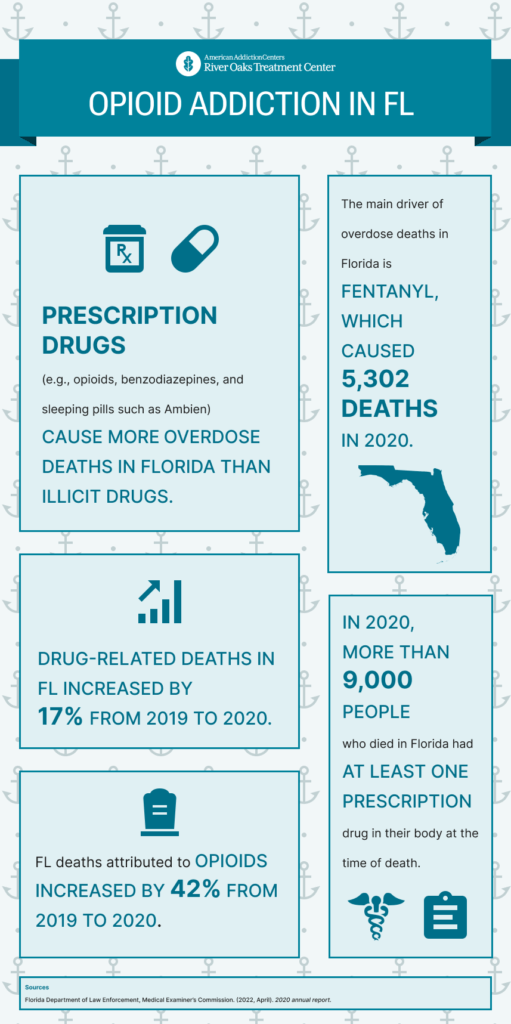
Drug-related deaths in FL increased by 17% from 2019 to 2020, with opioids driving the increase.1 More stats from the Sunshine State include the following:1,16
- The most common cause of overdose deaths in Florida is fentanyl, which caused 5,302 deaths in 2020. Cocaine and alcohol were the next most common causes of drug overdose deaths that year.
- In 2020, more than 9k people who died in Florida had at least one prescription drug in their body at the time of death.
- Prescription drugs (e.g., opioids, benzodiazepines, and sleeping pills such as Ambien) cause more overdose deaths in Florida than illicit drugs.
- Over the years, the state has worked to decrease the number of addictive prescription drugs it distributes. In 2022, Florida pharmacies dispensed more than 11.6 opioid prescriptions, a steady decline from the more than 16.9 prescriptions dispensed in 2018.
- Other harm reduction efforts are also underway. In 2022, the life-saving medication naloxone was administered 51,752 times.
Florida Harm Reduction Resources
There are various options in the Tampa area for other types of harm reduction services. These include:
- IDEA Exchange, Miami’s first needle exchange program that allows drug users to exchange used needles for clean ones to prevent the spread of bloodborne diseases. This organization provides a range of harm reduction services including:
- HIV and hepatitis C testing.
- Condoms.
- Kits for safe injection.
- Basic wound care kits.
- Overdose prevention training.
- Referrals to addiction treatment.
- Needle disposal sites throughout Florida.
A new needle exchange program based in Hillsborough County was also launched by The University of South Florida. Offered in conjunction with Tampa General Hospital, it will be only the second needle exchange program in the state.
Harm reduction can reduce the numbers of deaths as well as the rates of disease transmission;15 however, it only goes so far. The best prevention of opioid overdose is rehab treatment. We can help. Call us at to learn how you can begin a life no longer controlled by opioid addiction and find long-term recovery at our inpatient rehab center in Riverview, FL.